
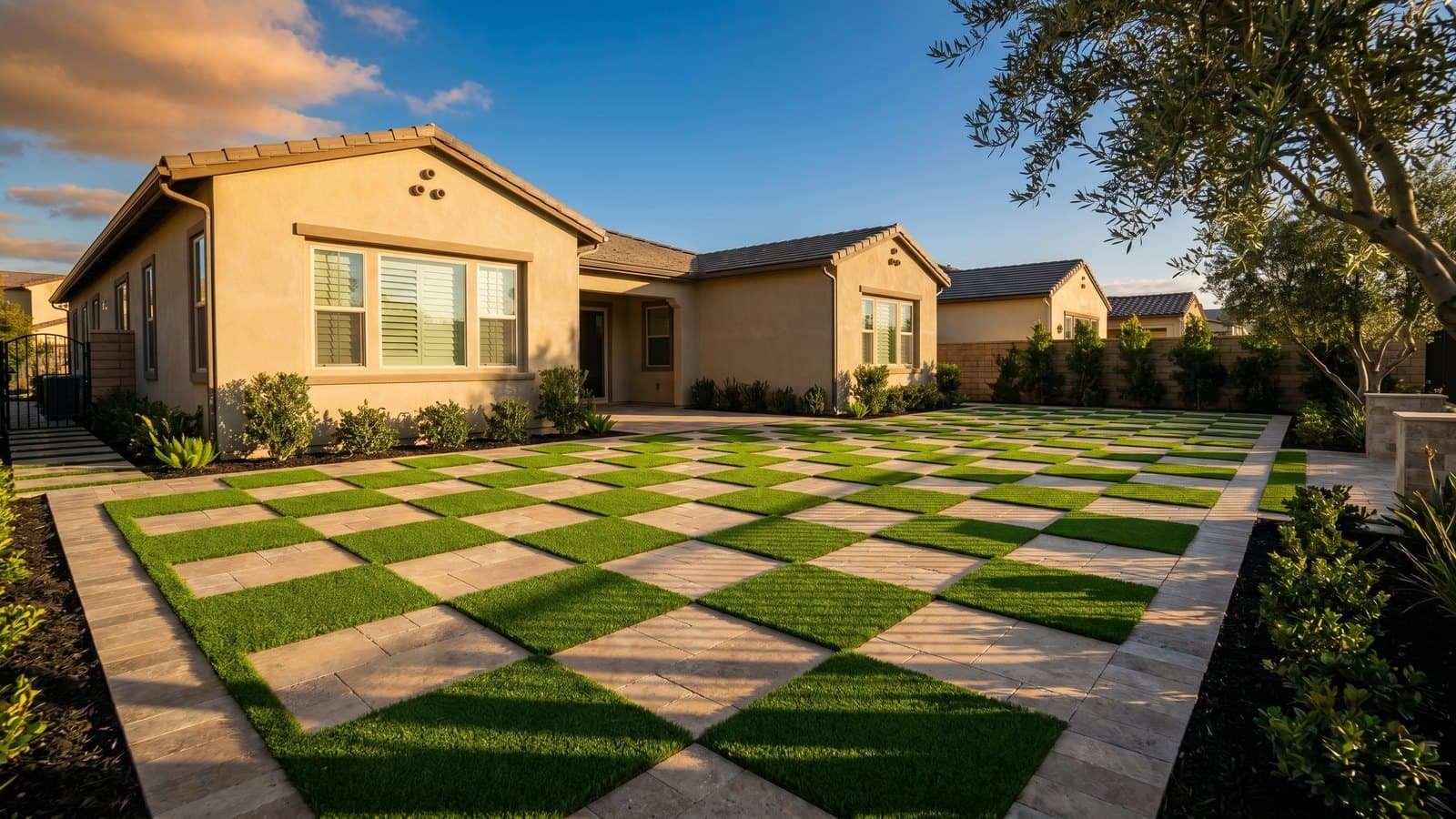
Pavers-and-turf design has become one of the most popular landscape approaches in Southern California, especially in premium markets where homeowners want a curated, architectural aesthetic. The integration goes beyond just placing turf next to a paver patio; geometric ribbon walkways, courtyard designs, and unified material lines elevate the landscape from functional to architectural. This guide covers design ideas and the technical execution that makes them work.
Why Combine Pavers and Turf?
Pure turf coverage reads as suburban; pure paver coverage reads as commercial. Combining the two creates visual interest, reduces required turf coverage (lowering install cost on premium products), and provides defined functional zones (entertaining areas vs lawn areas). Geometric integration done well reads as architectural rather than utilitarian.
Common Design Approaches
Paver Ribbon Walkways
Linear paver bands (typically 2 to 3 feet wide) running through turf bays. Creates clear walkway lines while maintaining turf as the dominant ground cover. Common in front yards and side yards. Hidden steel restraint between paver and turf keeps lines crisp.
Geometric Courtyard Patterns
Pavers and turf laid in geometric pattern (squares, rectangles, hexagons) across an entire courtyard space. The pattern becomes the design element. Common in modern architectural designs where the courtyard is a featured space. Requires precise base prep coordination so paver and turf finish grades stay flush.
Border Frames
Paver border (typically 24 to 36 inches wide) framing a turf interior. Defines the lawn area visually and provides a transition between hardscape and turf. Common around pool decks, where the paver border doubles as a wet-foot landing zone.
Stepping-Stone Patterns
Individual paver stepping stones placed within turf, spaced for natural walking stride. More rustic aesthetic than continuous ribbon walkways. Each stepping stone needs its own base prep to prevent settling that would create trip hazards.
Technical Execution: Why Most Pavers-and-Turf Designs Fail
Pavers-and-turf integration fails when paver base and turf base settle at different rates, creating trip hazards or visible step-downs at the transitions. Done correctly: paver base (Class II road base) and turf base (decomposed granite) are installed to identical depth (4 inches), compacted to identical density (95 percent), and finished at identical grade. Hidden steel restraint at the turf-paver edge keeps the line crisp and prevents lateral migration.
Material Coordination
Paver color and texture should complement (not match) the turf color and pile profile. Common combinations: warm earth-tone pavers with SYNLawn Lush; light-gray modern pavers with SYNLawn Precision; charcoal Belgian block with SYNLawn Premium. Bring multiple paver samples and turf samples to the homeowner during the design phase to evaluate combinations in actual property lighting.
Designer Coordination
Estate-scale pavers-and-turf projects typically involve a landscape designer specifying material selection and overall pattern. We coordinate base prep, drainage planning, and SYNLawn product selection with the designer's plan. The integrated approach delivers the architectural aesthetic while ensuring the technical execution holds up over the project life.
HOA and Permit Considerations
Pavers-and-turf designs in HOA communities (Beverly Hills, Newport Coast, Westlake Village) require HOA architectural review with detailed renderings showing both materials. Permit requirements vary; pavers-and-turf installs that change drainage patterns may need permit submittal in cities with stricter landscape modification rules. We provide stamped product documentation and project plans for permit packets.